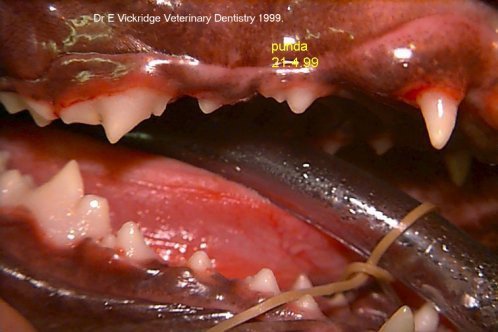
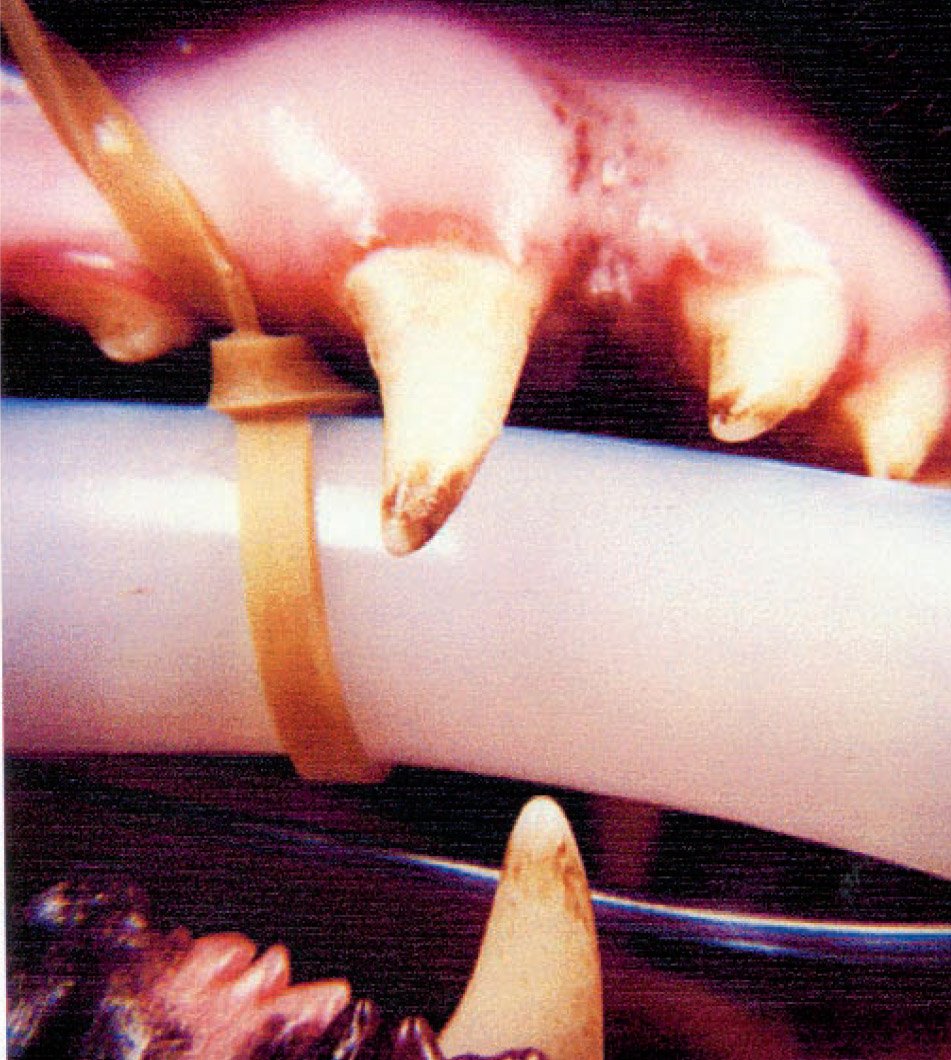
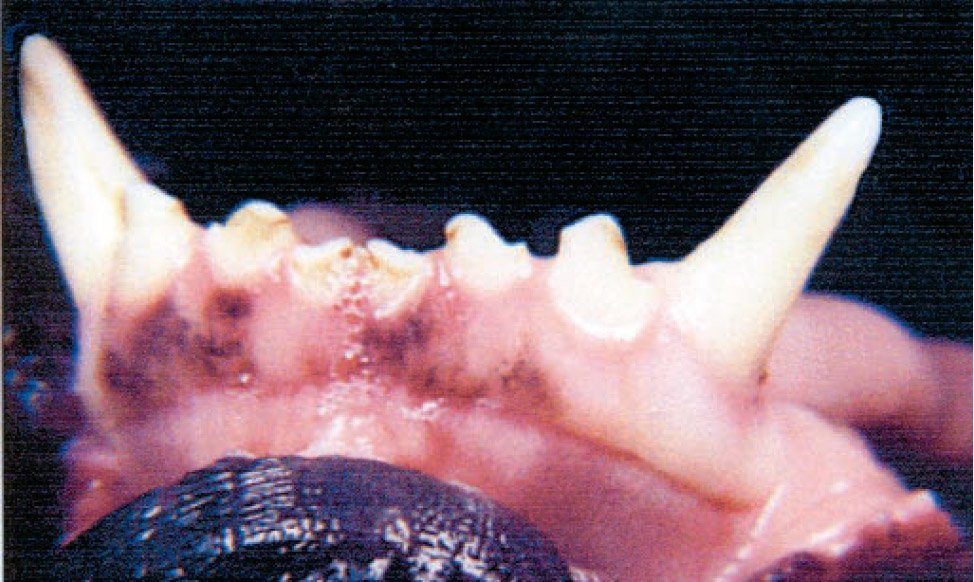
Amelogenesis imperfecta (AI), also known as familial enamel hypoplasia (FEH), is a hereditary dental disease that affects the teeth and their development in dogs. Deciduous, or puppy teeth, appear normal, so this is often not diagnosed until the permanent dentition erupts. Dogs with AI do not have proper enamel deposition on the teeth, giving the teeth a roughened, irregular surface and a more sharply pointed tip. AI can occur in different degrees, some dogs only mildly affected with small areas of enamel loss on the canines or molars, while still having rounded tips and a degree of smoothness to the teeth, while others will have the entire dentition involved. In places where the enamel is not present, the second tooth layer, the dentin, is exposed. This is more susceptible to bacterial invasion, plaque deposition and staining which can lead to lifelong dental disease and pain.
AI is inherited in an autosomal recessive manner, meaning that dogs must receive two copies of the mutated gene to develop the disease (Affected dog). Non-carrier dogs are free of this gene and cannot pass a copy of it to their young. Carrier dogs (only affected by one copy of the gene) do not usually have features of the disease, but can pass one copy of the gene on to their offspring. There is a genetic marker for AI in Akitas and genetic testing companies can provide carrier vs. non-carrier information for breeders. As of the writing of this article, these two labs offer the genetic testing specific for Akitas:
Orivet.com Amelogenesis Imperfecta Genetic Testing >>
Laboklin.co.uk Amelogenesis Imperfecta (AI) / Familial Enamel Hypoplasia (FEH) >>
This information should be useful to breeders when making decisions of which dogs and bitches they wish to breed.
Breeding a non-carrier to a carrier will produce a litter of 50 % puppies that will be carriers for AI and 50 % non-carriers
Breeding an affected dog (dog with AI) to a non-carrier will produce a litter of puppies that will all be carriers for AI.
Breeding a carrier to another carrier will produce a litter that will statistically have 25% affected, 25% non-carriers, and 50% carriers.